

Welcome to Holy Nonsense, where we laugh at religious absurdity!
Today’s edition is presented by Reign of Error! On 4/23, Axis Mundi is hosting a wide-ranging conversation on Christian nationalism, escalating tensions with Iran, and the dangerous resurgence of “holy war” rhetoric in American politics.
Christians loooooove to tell former Christians “you were never a real Christian.”
They’ll cite 1 John 2:19:
“They went out from us, but they did not really belong to us. For if they had belonged to us, they would have remained with us; but their going showed that none of them belonged to us.”
So, let me get this straight: a man (who is not Jesus) said that if we leave, we were never one of them?
And this was written decades after Jesus died.
Wouldn’t it be convenient for them to write something like that?
“If you leave this belief system, you were never really a part of it.”
That’s dismissive, yet effective.
It’s also pretty culty.
Erik said something similar:
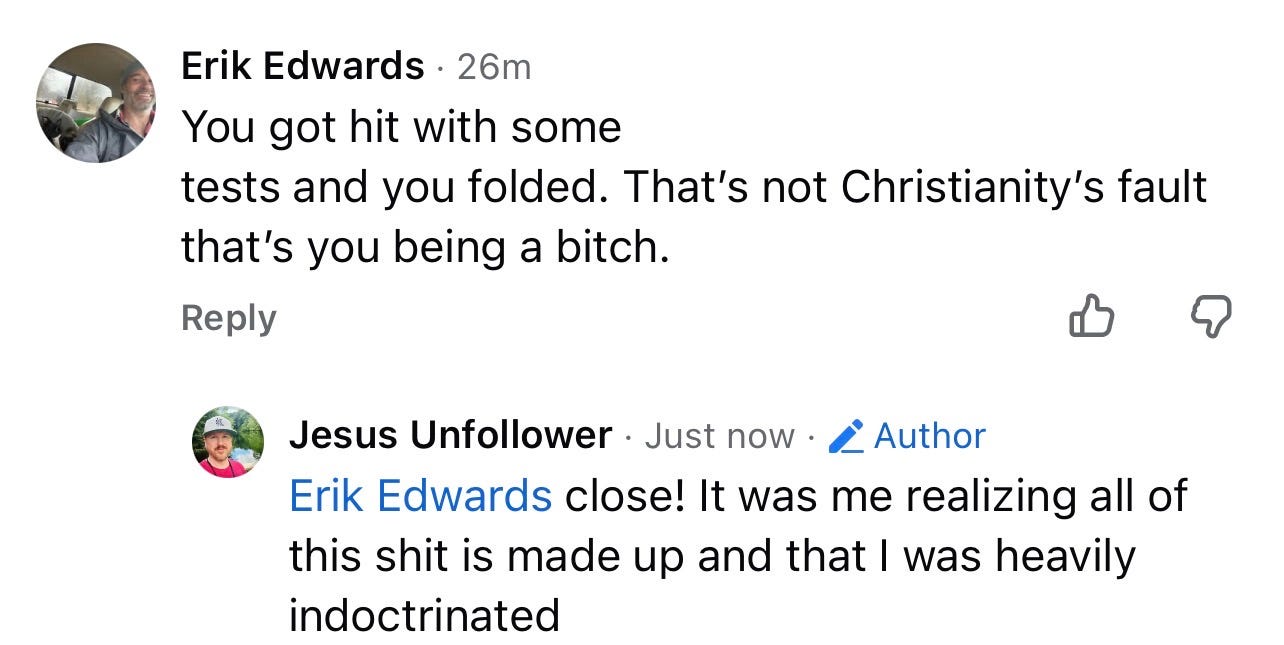
The “tests” that I got hit with were “Oh, yeah, this doesn’t really make sense. The only reason I believe it is because I was told to do so from a young age.”
Mystery solved, Scoob.

Sounds like maybe Erik is scared to ask questions.
Thank you to Cara, Kathy, and CK for becoming the most recent paid subscribers!
Consider becoming a paid subscriber. It’s $5/month to join, which is roughly the price of a Cheesy Gordita Crunch. You’ll be helping me fight Christian nationalism and fueling my Taco Bell addiction.
And remember: you don’t need a god to be good!
Kevin

A wide-ranging conversation on Christian nationalism, escalating tensions with Iran, and the dangerous resurgence of “holy war” rhetoric in American politics. Drawing on their expertise in religion and political extremism, the panel will analyze how theological narratives—particularly those rooted in spiritual warfare and dominionism—are shaping public discourse, foreign policy attitudes, and grassroots sentiment. Together, they will explore how these ideas frame global conflict in apocalyptic terms, blur the line between faith and state power, and raise urgent questions about democracy, pluralism, and the consequences of sacralizing political violence.